Wednesday, April 26, 2023

The Gift of Faith - Wednesday, 3rd Week of Easter

One of the great gifts that I have received is the gift of faith. And one of the great graces I have received is the knowledge that not everyone has the gift of faith.

It may be odd to say that, but not everyone has the gift of faith. And when I say "gift," I'm not talking talent or ability. We do not "achieve" our faith. Thinking of faith as simply an achievement or a human action is akin to the heresy of Pelagianism which says that we can achieve our salvation ourselves, independently of grace.

Salvation is a gift given. And so is faith. Our task is to respond to that gift, just as Jesus has exhorted us to when He says, "Whoever believes in the Son will have eternal life" (John 6:40). Because He exhorts, trust that He will also give the gift to do so.

When it comes to the treasure of faith, not only have some people not yet received that grace -- and only God knows why -- but it is also worth noting that some have had faith and have lost it; as Paul says, "Some of you have made a shipwreck of your faith!" (1 Timothy 1:19)

So, not only should we have a gratitude for the grace of faith, we should also protect that treasure we have been given. Shoot, haven't you noticed how much signage is used in construction zones? So many orange signs! And the biggest of all signs -- Road Closed -- often with a barricade, alerts us and sometimes even physically prevents us from driving into danger, even the danger of driving off a yet-unfinished bridge.

If that is the case with our mortal lives, that we treasure them enough to protect them, then shouldn't we at least ask what we are doing to treasure and to protect the greatest gift God could give us, that is salvation and its accompanying gift of faith? Jesus connects salvation and faith when He says "Whoever believes... will have eternal life."

More zealous Protestants (often of the evangelical variety) sometimes accuse Catholics of being (... how shall I say?) ... sleepy. "If you claim to actually have Jesus at the Eucharist, then why do you never talk about it?" There is a caricature (and as such is partly true, partly not) that Protestants really know their Bibles. Is there a caricature that Catholics really worship the Eucharist? To some degree, I suppose.

And is that all a judgment of hearts? To some degree, yes. And shame on anyone who does so.

But the point here is that the largest Christian group in the United States is fallen away Catholics. And they either did not have the gift of faith, or know its value, or -- knowing its value -- endangered it and made a shipwreck out of it. And who knows why or how.

But we better be darn certain that the enemy, the ancient serpent, would absolutely love you to lose it, too. And he's not often brazen about it ("spit on the crucifix, will you?"). Rather, he just gets us to ... give a little away here and there. And a little more lukewarmness. And then a little sleep-walking in the faith.

Have you ever been in your car, driving, and realize that after a mile or so, you have no recollection about how you got to where you are? I've done that a couple of times and it is terrifying. "What in the world got me so distracted that I wasn't paying attention to the road??!?"

What has gotten me so distracted that I'm not attending to the faith and to the Eucharist??!?

Perhaps we need to put up some roadblocks to protect this treasure: more frequent confession; more frequent visits to the Adoration chapel; leaning in to the awkwardness of inviting people to Mass, even daily Mass; studying about the Eucharist and the saints that died for it; getting excited about it again; praying on the knees; really fasting before Mass; getting here early to just be with Him (because I really can't live without Him!). 

And that's where the enemy often get's us. While he doesn't say "you could live without Him," he does say, "Well, you don't have to do ... that..."

Gosh, if we evangelized, knelt, studied, adored, fasted, and couldn't live without Jesus in the Eucharist, how many barricades of protection we would have around this amazing treasure! How difficult it would be to fall away.

And if this treasure is connected to eternal life as Jesus says, doubling down ("Amen, amen, I say to you, unless you eat the flesh of the Son of Man and drink his blood, you do not have life within you. Whoever eats my flesh and drinks my blood has eternal life" (John 6:53-54) -- if the Eucharist is connected to heaven, then shouldn't we do everything to treasure and protect that grace of faith that believes this?

Friday, April 21, 2023

The Gift of Stability - 3rd Sunday in Easter

What is stable in your life? 

If there is one thing that humans all look for in life, it is stability – something we can hang our hat on or build our life upon: a good job, a steady relationship, a retirement fund, stable mental health, a perennially true church and religion. We all want things to be stable. 

It’s when things are unstable that we become stressed and we enact plans to bring about a stable resolution. 

For the two disciples on the way to Emmaus, their world had been turned upside-down when Jesus had been crucified. And so they flee the instability. 

Jesus draws near to them in this moment. And the first thing He says to them is: “Tell me about it.” Tell me about what is uncomfortable and out of control in your life. Why are you running to Emmaus? Why are you seeking stability there and not in the city of the Lord, that is Jerusalem? 

I love how honest the men are with Jesus. They say, in effect, “Haven’t you been watching the news? Sheesh, you must be really out of touch!” 

What happens next is a pivotal moment in their lives. So pivotal that it turns them right around. Knowing that we humans seek stability, I venture to ask: what happened in this moment such that their entire perspective about Jerusalem was changed and they saw that returning to that city was a more stable move than running to Emmaus? 

The Patristic Fathers, that is the earliest teachers and saints in our faith, note that these two disciples on their way to Emmaus went to the first holy Mass – the first after the Last Supper 

Walk with me for a minute. 

The first thing the disciples do is bring their concerns to the Lord. We do this when we come to Mass and kneel when we arrive. Holy Mass doesn’t simply begin when the priest comes down the aisle. It begins when we start to open our hearts to Jesus and tell Him about what’s going on. This is an often overlooked but essential part of Mass. It is why I encourage musicians not to practice before Holy Mass – people need quiet in order for this essential moment of recollection. 

The next thing that happens is that Jesus opens up the Scriptures to them. There is rebuke and challenge, yes, but He shows where He has been in their hearts. And as a result, the two disciples’ hearts were burning within them. This corresponds to the part of the Mass where the readings are proclaimed and the homily is given. And if a homily seems to be spoken just to you, be assured that is Jesus speaking to you. Don’t take that for granted. 

In response, the disciples pray: “Stay with us, Lord.” This corresponds to the offertory. The offertory, where bread and wine are brought to the altar in the middle of Mass is not a commercial break. It is actually a moment when we ask Jesus to stay with us and receive us and all that we have. 

Then, Jesus takes bread, blesses it, breaks it, and gives it to them. This is the part of the Holy Mass which is called the consecration and then the reception of Holy Communion. 

Notice, however: it says that Jesus “vanished from their sight.” Did He leave? And thus not answer their prayers to stay? 

No. He was right there on the altar, truly with them on the way. 

From there, the disciples run back to Jerusalem and announce to all who will hear—even to announcing to the Apostles, the first Bishops!—that they had met Jesus on the way. This is the end of Holy Mass, where we are told to “Go.” Go and do what? Tell others whom it is you have met here. 

This is all to say that the first Mas was the pivotal moment in the two disciples’ lives. 

And far from being a boring moment, it was the pivotal moment that turned their hearts (as well as their feet) and oriented them into the adventure of facing the chaos, the heart-break, the instability, and the Cross back in Jerusalem. Far from being the “opiate of the Masses” as some cynical people have said, the Holy Mass is precisely the place where we encounter Reality so as to face Reality. 

I’ve offered the Holy Mass at the catacombs. I’ve offered Holy Mass on the sides of mountains. I’ve offered Mass at the tomb of St. Peter. I’ve offered Mass at our local parish church. And at bedsides and at funerals ...  And if I am honest and vulnerable with Jesus and tell Him what is really in my heart, no matter where I am, no matter how chaotic or unstable the world is around me, I meet Jesus, the rock, the foundation upon which I can build my life. 

Far from having to adapt the Holy Mass to our likings and newest fashions, we simply have to open our hearts to Jesus here. The Holy Mass is the most stabilizing force in the world. And He will meet us, on whatever road in life we are on. 

What is most stable in your life? 

May you find it here in the Holy Mass. 

In the Name of the Father, and of the Son, and of the Holy Spirit. Amen. 

Monday, April 17, 2023

The Gift of the Touch - Divine Mercy Sunday (2023)

He is Risen! (He is Risen indeed!)

I'm sure you want to get more out of Easter, more joy, more spiritual depth. To do that, I want to start today with a question for reflection. Here's the question:

When it comes to faith, what moves you?

For me, I can be moved by the glory of nature -- the mountains, the power of a storm ... But I can also be moved by an illness. (Nothing slows me down and gets me to prayer quicker and with more feeling than the flu. Ugh!). So, whether glory or the cross, I can be moved.

What moves you?

Thomas had been moved by the Cross. Of course, he had been moved in the opposite direction of faith, but he had been moved. The Cross scandalized him. The experience could have moved him the other way, of course; like Mary, the Mother of Jesus, it could have deepened his love for Jesus -- see how much He loves me! But the Cross was a scandal for Thomas.

And his friends -- their testimony could have moved him, too. But Thomas was incredulous. He had been with his friends for nearly three years; he knew them; and yet he did not believe them. He didn't believe the Blessed Mother, even! That's when you know you are in a bad spot: when there is no one you would listen to.

And who knows why. Maybe Thomas was blinded by the hurt, by the scandal. Maybe he wanted more. Maybe he didn't know what he wanted. But whatever it was, he was living out of that -- hurt, desire -- instead of living from love and belief. He was living from doubt.

A word about doubt. Doubt is different than difficulty. Doubt says, "I won't believe until you prove it to me," and that is going to take a lot. Probably a miracle. Or a really good argument. Difficulty, on the other hand, says, "This teaching is hard, so please help me understand it." Difficulty knows that something is, well, difficult, but speaks from good will and from the "benefit of a doubt." I believe you, it says, but it is really hard for me to see how this is. It will take the hand of friendship, trusting that there has been friendship there.

When I was in college, I struggled with doubt. I had been hurt and, coupled with the philosophy I was learning, I started to doubt a lot of things: not only the faith, but authority figures, and to some degree: reality. When that happens, we become our own Pope; my own authority, individualistic, and sadly isolated. In time, I realized that I was not infallible; I was finite, mistake-ridden, temperamental. I was poor as my own authority. I doubted myself. At that point, what can one believe in? ... I was in a bad spot. And the only thing that could save me was a miracle -- and a good argument.

One of my friends said to me: "Anthony, have you ever doubted your doubt?" Great question. You see, I had doubted everything -- authority, myself, reality -- but there was one thing I did believe in: my own doubt! How silly! And as soon as I doubted that -- truly brought my logic to its full bearing and conclusion -- I could begin to taste fresh air again. "What if there was more to life than doubt? What if... what if belief... was the right path?" I had followed doubt's path to its end: nihilism, nothingness, and despair -- and to be told that this was not the only road, but that there was another path, a way of light?! Oof! What a grace!

This is where Jesus draws Thomas in. Jesus speaks from a heart of friendship. When he says to Thomas, "Here, put your finger in my side," he is not only giving permission to Thomas; Jesus is also saying to Thomas: "I know you have been hurt. Let me help you. Doubt is not the only way."

And notice: this is not a grace given to Mary Magdalene. Jesus had said to her, "Do not touch me." Not only did she not "need" to touch (although she really wanted to), but she had never lost her friendship. She never stopped believing in Love. The gift of the touch was to be given to Thomas precisely for this moment, for Love's renewal in Thomas. Thomas was special -- and this gift was reserved for him.

So what did Thomas touch? Yes, Jesus' side. But remember why it was the side. On the one hand, it was the place where the centurion had pierced Jesus. It was the place where blood and water had flowed -- and had brought conversion to the Centurion! It was the place of new faith. Of where conversion would happen for Thomas, too ... It is also, mystically, the place of new creation: God the Father had taken flesh from Adam's side so as to create Eve. Jesus is the New Adam and from His side would come the Bride, the Church. Thomas touches the mystical beginnings. And that was fitting, given that Thomas was an apostle on which the Church would be built.

And more: when Thomas touched Jesus' side, it wasn't as though Thomas just touched the flap of skin. His finger went in. And, going in, his finger touched the heart of Jesus. And found it alive. Beating. Thomas touched the alive, beating, and glorious heart of Jesus Christ! And so it makes sense that Thomas exclaims: My Lord and my God! as though to say Oh my goodness! He's alive! He's really real!!!

But there is another meaning to this exclamation. In addition to faith, there is repentance. You see, the prophets had foretold that the Messiah would bring about the justice and judgment of God. In one place, Jesus Himself even talks about how the Messiah will slay the enemies of God (see Luke 19:27). Thomas had abandoned the Messiah in His hour of need. My Lord and my God, Thomas could also fearfully and repentantly say, please do not kill me!

This is why Jesus says, "Peace be with you."

I'm not going to kill you, Thomas. I wouldn't destroy you. You are important to me. You are my friend. You believe. And that is enough for me. I am pleased to give you my forgiveness -- instead of judgment, I give you mercy.

Thomas, knowing personally this mercy, is now sent as an Apostle not only of faith, but of mercy: Go, and forgive others as I have forgiven you. A good confessor, you will find, will himself know the mercy of God.

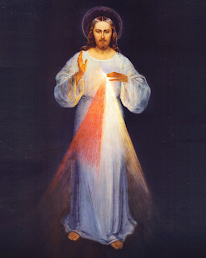
It is important here to point out that the Divine Mercy image (which says at the bottom, Jesus I trust in you) has a mirror image. And that image is the Sacred Heart.

You see, the Divine Mercy image is of the Sacred Heart. This is what the Divine Mercy image is. You see, the image you are used to seeing is of Jesus, but in His Resurrection. He points to His Heart, and from His Heart comes the light, red for the blood of the Eucharist, white for the waters of Baptism.

Whereas the Divine Mercy image is of the Resurrected Heart, the traditional Sacred Heart image is of the Heart of Christ crucified: it is pierced, crowned with thorns, and on fire with the Holy Spirt of Love. His hand is extended to you, inviting you to touch...  It is the Divine Mercy image, but seen through the lens of the Crucifixion.

That is to say, in His Mercy, Jesus knows that sometimes we are touched by the Crucifixion; other times we are touched by the Resurrection. We can be moved by glory ... we can be moved by sickness.

Some of us are moved more by Lent. Some of us are more moved by Easter.

The important thing is that we are moved. And it is the Mercy of Jesus by which He desires to move us.

You see, some of you may not have been moved much by Lent. And that is okay. Jesus wants to move you in this Easter Season. In fact, in the forty or so days that remain of this Easter Season, I humbly propose that there is just as much grace-- if not more-- in this moment than there is in Lent. 

If you are more moved by glory, this is your time to be moved! 

This is the time where you can receive such a deepening in faith; and, by faith, a deepening in repentance and of encountering God's Mercy -- which, having encountered such a gift, necessarily leads to gratitude and joy.

And so, in the weeks ahead, walk around in that question: what moves me?

Is it the Cross? Is it the Glory?

In the end, it wasn't simply that Thomas got to touch Jesus. In the end, it was Jesus who bestowed the Gift of the touch -- and touched Thomas. Right to Thomas' heart.

Let us pray ... 

Jesus, bring healing to my heart and my faith. Touch my soul. From any scandal that has hurt my faith, heal me. From any hurts in my past that have led me to doubt you and those that love me, heal me, Jesus. Touch my heart and renew me by your mercy! Amen!

In the Name of the Father, and of the Son, and of the Holy Spirit. Amen.

Wednesday, April 12, 2023

Stay With Us, Lord - Wednesday in the Easter Octave

I know you want to "get more" out of Easter. And there is a two-sided key that will help with that. One the one side, you will see that we are constantly referring back to the Resurrection and seeing how this is the source of our faith; on the other side of that key, you will see that Jesus is moving us to the Ascension and to Pentecost; there is still more (!!!) to come. Jesus isn't done yet. And from these great moments will come the new community which we call the Catholic Church. So the key is past-facing (Resurrection) and future-facing (the early Church). These Easter days, then, are pivotal.

So, for this morning, we see this key in action as we are brought back to the night of the Resurrection (Gospel) and we are also brought forward to the early days of the Church (1st reading, Peter healing a man).

The pivotal moment in this Easter day happens as Jesus meets the two disciples on the way to Emmaus. It is pivotal not simply because He meets them. It is pivotal because of how He meets them.

He meets them in the precise way that He is meeting us now: at the Holy Mass.

First, He gives the two men a chance to open their hearts to Him. They do so. This is the preparation of Holy Mass, as we kneel and talk with Jesus before the formal beginning of Mass.

Second, Jesus opens up the Scriptures to them and interprets to them everything that belongs to Him. These are the readings and the homily at Mass.

Third, they ask Him to "Stay with us." It is an interesting prayer. Jesus is Emmanuel (God with us), after all. And, later on, at His Ascension, Jesus will promise: "I will be with you always." At their request, Jesus stays with them -- but in doing so He "took bread, blessed, and broke it, and gave it to them." These are the exact words that were said just a few days prior at the Last Supper and they are the same words we say at the Eucharist at Holy Mass.

And it says that Jesus vanishes from their sight.

So.... did He not answer their prayer? Did He leave them? .... No. He is there on that table/altar. He is there in the Eucharist.

Fourth detail, the disciples then run back to Jerusalem and announce that they met Jesus. This is the end of Mass: "Go and announce the Gospel with your lives!" Evangelization.


Now, it is very important to note where the two disciples ran to in Jerusalem. They ran to the Upper Room. That's where the Apostles were huddled on that Sunday night "for fear of the Jews." They tell what had happened along the way. And then, right after that (in a moment you don't hear about in today's reading, but which is noted elsewhere in the Gospels) Jesus appears to them, and says to them "Peace be with you." He then breathes on them, and tells them they are to forgive sins.

Please note: this is the same Upper Room where He inaugurated the First Mass. It is the same Upper Room where He transformed His apostles into Priests. And now, in this same Upper Room, He is giving them the power to forgive sins.

For the next 40-50 days, we are going to see the Apostles grapple with the events of this pivotal moment. But we are also going to see (in our First Reading) how they are living out their priesthood.

This is where the Ascension and Pentecost are going to be crucial. The Ascension and Pentecost are not just "nice add-ons" to close out the Easter Season. As we will see later on, those feasts are the very moment in which the Apostles are given the power, by the Holy Spirit, to do what Jesus has been instituting them to do this whole time.


I hope this view from 30,000 feet gives you a sense of the Easter Season and its joy and purpose.

I also hope it transforms your understanding of the Eucharist: that we are not receiving a dead Jesus here, but when you receive the Eucharist, you are receiving the same Jesus who is Resurrected. And it is the great feast of Pentecost that will give ordinary men like Peter the very power to bring the Resurrected Christ here, to this very altar, in answer to our prayer: Stay with us, Lord!

+

Tuesday, April 11, 2023

Do Not Touch Me - Tuesday in the Easter Octave

 "Do not touch me."

These are very odd words from Jesus. Mary Magdalene is overjoyed! -- her Jesus is alive! How could she not touch Him (and hug Him and tackle Him to the ground)?! It is such an amazing moment; her heart is truly about to burst. So why these seemingly cold words?

On the one hand, to touch the Risen Lord is a gift that Jesus is reserving for a certain Thomas. He needs to touch first; Mary Magdalene already believes by seeing. Thomas will believe by touching.

And on the other hand, Jesus wants more than for Mary Magdalene to touch Him. 

You see, previously in His ministry, Jesus had told his disciples: "Remain in me." Please note the preposition "in." He does not say remain "with" me. ... What is the difference? "With" is a side-by-side companionship. A co-pilot. A buddy. ... But Jesus wants more than that. He wants to literally be "in" us and us "in" Him. The only way the "in" can be explained is what is said in Paul's Letter to the Ephesians (chapter 5) when Paul is discussing the union of husbands and wives. He says Jesus "nourishes his body" with His own body and blood -- and "the two become one flesh." This wasn't simply in reference to human marriages but to "a great mystery and I speak in reference to Christ and the Church."

What does this mean? Jesus tells Mary not to touch Him because He is going to give her a greater gift: His very self in the Eucharist. And He will literally be "in" her and she "in" Him. A true communion! Touching is not enough -- He wants more for her!

And that's such an important reality right now. Easter is amazing, but Jesus is saying to Mary and to all of us: "But wait! There's more!"

We still have the Ascension ... We still have Pentecost. These are not nice "additions" to our faith. They are essentials, actually. It is by the Holy Spirit at Pentecost that the Apostles will be able to change bread and wine into Jesus' Body and Blood.

And that's the more: "Do not touch me," Jesus says, "Because I have something even better. And my brothers will give you this more when they give you myself present in the Eucharist. Then, you will not just be with me. But you will be in me and I in you."